Author : Amarjeet
The GMT will be one member of the next generation of giant ground based telescopes designed to provide unprecedented clarity & sensitivity for the observation of astronomical phenomenon.
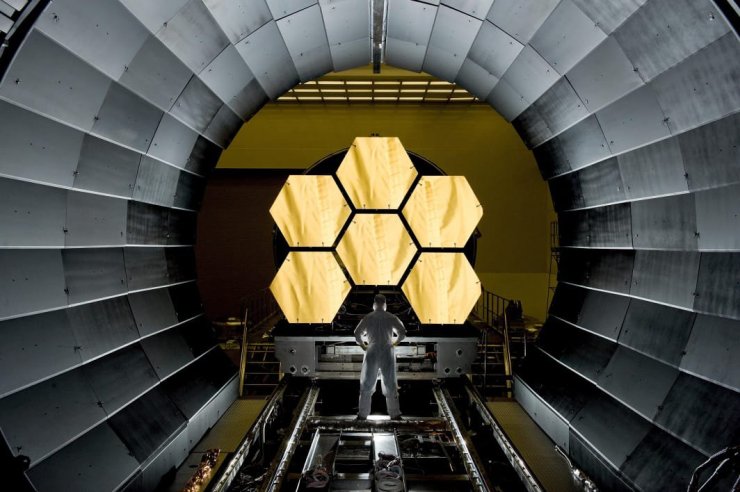
The GMT uses 7 of the largest astronomical mirrors that form a single optical system that can produce 10 times sharper images than the Hubble space telescope. The GMT is located at Carnegie Institution for Science’s Las Campanas Observatory, built on a peak in Andes Mountains, Chile.
SPECIFICATIONS
Since we can’t make a single mirror larger than 20 feet in diameter due to material properties of glass, so 7 mirrors are combined to form one optical surface than brings the light to a single focus. The seven segments have a diameter of 8.4 m, that will observe optical and near infrared light, with resolving power of 24.5 m primary mirror and collecting area equivalent to 22 m one, which is about 368 sq.m.
Elevation – 2500 m
Wavelength Range – Optical to Infrared
First Light Target Date – 2024
Telescope style – Gregorian telescope & Optical telescope
INSTRUMENTS USED
G-CLEF Visible echelle spectrograph
GMACS Visible multi-object spectrograph
GMTIFS Near IR IFU and adaptive optics imager
GMTNIRS Infrared echelle spectrograph
MANIFEST Facility fiber optics positioner
WORKING
The mirrors are held by strong steel framework that provides it enough stiffness that it doesn’t shake due to wind. Its precise enough to steer it across the sky to observe planets and stars, & is so sophistically made that is no vibrations.
The entire telescope which weighs around 1000 tons floats over a thin film of oil and is completely frictionless.
One of the most sophisticated engineering aspects of the telescope is the “adaptive optics”. The telescope’s secondary mirrors are flexible. Under each secondary mirror surface there are 100 of actuators that will constantly adjust the mirrors to counteract atmospheric turbulence. The actuators are controlled by advanced computers which will transform twinkling stars into clear steady points of light. It is in this way that the GMT will offer images that are 10 times sharper than the Hubble Space Telescope.
The project conducted its first substantial external review in 2 October. GMTO announce the beginning of construction in July 2014. The project is scheduled to achieve first light with a subset of the primary mirrors in 2024, with full operations beginning around 2026
“A Soul Without imagination is what an observatory would be without a telescope “
 Scitech Labs
I never had heard about this before . Beautifully written !!
LikeLike
Thanks
LikeLike
It was amazing to know such a new concept really fascinating….:-)
LikeLike